

Yeosu’s 9th Municipal Administration Unveils Vision: “Into the Citizens, Into the World, Yeosu Leaps Forward Again”
- Date
- 2026.07.28 16:45
- Views
- 33
- Registrar
- 여수시청
Crisis Response and Citizen Sovereignty Planning Committee reports on 18 days of activities, presenting 77 pledges and 45 policy proposals.
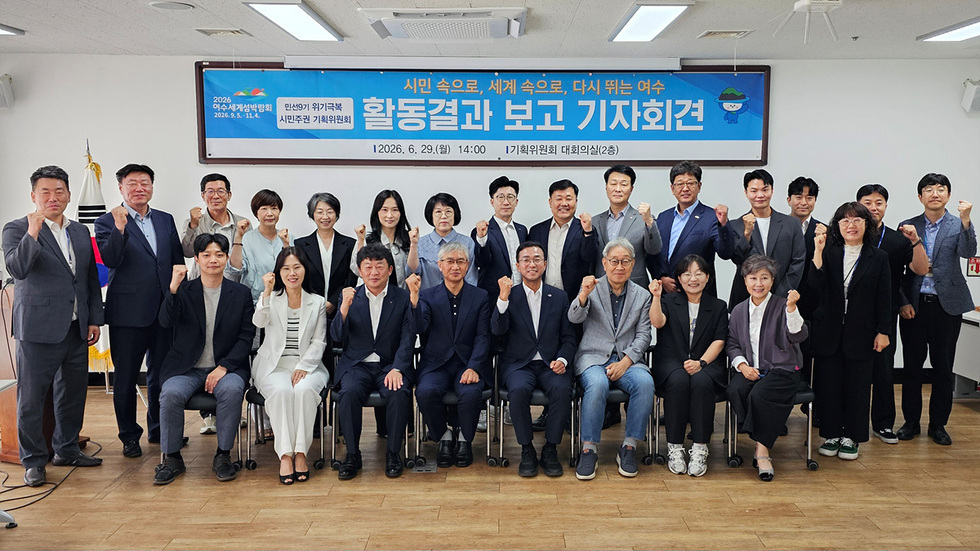
The Crisis Response and Citizen Sovereignty Planning Committee, the transition committee for Yeosu’s incoming 9th municipal administration (Chair Ahn Gi-wan), held a briefing on the results of its activities on the 29th and delivered a final report to Yeosu Mayor-elect Seo Young-hak outlining the vision for the 9th municipal administration, 77 pledges, 45 policy proposals, and directions for fiscal management.
Since its official launch on the 12th, the committee—composed of 15 members and 15 advisory members—spent 18 days laying the groundwork for the new administration through four subcommittees: Citizen Sovereignty Planning, Locally Led Growth, Improving Citizens’ Quality of Life, and a special subcommittee for the 2026 Yeosu World Island Expo.
The proposed vision for the 9th municipal administration is: “Into the Citizens, Into the World, Yeosu Leaps Forward Again.”
The vision reflects three core directions: a citizens’ sovereignty administration that places citizens’ voices at the highest priority in municipal affairs; a leap toward becoming a global city by connecting Yeosu’s marine, island, tourism, and industrial resources with the world; and economic dynamism aimed at overcoming structural crises such as population decline, economic slowdown, and pressure for industrial complex transformation.
The committee also presented five key policy directions for city administration: Citizen-Sovereign Yeosu, Where Citizens Come First; Happy Yeosu, Built on Strong Foundations; Future-Leading Economic Yeosu; Attractive Yeosu, Sought Out by the World; and Future-Ready Yeosu, A Great Place for All to Live.
The pledges were organized into 77 tasks across eight sectors, including welfare, culture and tourism, urban transportation, and public administration. Taking into account both citizen impact and feasibility, the city plans to implement them in phases based on timelines of 100 days, 6 months, 1 year, 2–3 years, and 4 years.
Major pledges include operating a Citizens’ Sovereignty Committee and establishing a system for on-site response within 48 hours through a dedicated citizen hotline; creating a KRW 100 billion Yeosu Future Fund; laying the groundwork for a Yeosu-style “basic society”; establishing a stay-oriented tourism model centered on visits of three nights or more; and pursuing a high-speed rail connection that would reduce travel time between Seoul and Yeosu to around two hours.
The committee diagnosed the current circumstances—marked by declining local tax revenues and growing welfare and investment demand—as an emergency fiscal management phase. It accordingly proposed reducing the issuance of local bonds except for essential projects, readjusting the mid-term local fiscal plan, managing the total volume of nationally funded competitive grant projects, minimizing carryovers and returns in national and provincial subsidy programs, and reviewing recurring private-sector subsidy programs.
Regarding organizational operations, the committee presented five basic principles: function-oriented management, field-oriented administration, accountable governance, flexibility, and efficiency. It also emphasized the need for a municipal control tower function capable of overseeing complex pending issues, including industrial complex transformation, marine tourism, island policy, cooperation with central government ministries, attraction of public institutions, and expansion of transportation networks.
Chair Ahn Gi-wan stated, “To ensure that the 77 pledges become not merely promises but actionable municipal tasks, we organized them by sector and target group while also setting out implementation timelines and directions for fiscal management.” He added, “We hope the 9th municipal administration of Yeosu will make a responsible start under the twin principles of overcoming crisis and realizing citizens’ sovereignty.”
Mayor-elect Seo Young-hak said, “This report is the first proposal for the 9th municipal administration of Yeosu, prepared through numerous meetings and on-site discussions.” He added, “We will carry out pledges and policies in the direction citizens want, and we will move swiftly on tasks that can be implemented immediately.”
He continued, “For tasks that require budgetary and institutional review, we will establish phased plans and explain them transparently to citizens.”
Meanwhile, rather than holding a large-scale inauguration ceremony on July 1, Mayor-elect Seo is scheduled to begin his first official duties of the 9th administration with a visit to the Memorial Tower to pay respects, an on-site executive meeting at the venue of the 2026 Yeosu World Island Expo, and a meet-and-greet with members of the press.
The Crisis Response and Citizen Sovereignty Planning Committee, the transition committee for Yeosu’s incoming 9th municipal administration (Chair Ahn Gi-wan), held a briefing on the results of its activities on the 29th and delivered a final report to Yeosu Mayor-elect Seo Young-hak outlining the vision for the 9th municipal administration, 77 pledges, 45 policy proposals, and directions for fiscal management.
Since its official launch on the 12th, the committee—composed of 15 members and 15 advisory members—spent 18 days laying the groundwork for the new administration through four subcommittees: Citizen Sovereignty Planning, Locally Led Growth, Improving Citizens’ Quality of Life, and a special subcommittee for the 2026 Yeosu World Island Expo.
The proposed vision for the 9th municipal administration is: “Into the Citizens, Into the World, Yeosu Leaps Forward Again.”
The vision reflects three core directions: a citizens’ sovereignty administration that places citizens’ voices at the highest priority in municipal affairs; a leap toward becoming a global city by connecting Yeosu’s marine, island, tourism, and industrial resources with the world; and economic dynamism aimed at overcoming structural crises such as population decline, economic slowdown, and pressure for industrial complex transformation.
The committee also presented five key policy directions for city administration: Citizen-Sovereign Yeosu, Where Citizens Come First; Happy Yeosu, Built on Strong Foundations; Future-Leading Economic Yeosu; Attractive Yeosu, Sought Out by the World; and Future-Ready Yeosu, A Great Place for All to Live.
The pledges were organized into 77 tasks across eight sectors, including welfare, culture and tourism, urban transportation, and public administration. Taking into account both citizen impact and feasibility, the city plans to implement them in phases based on timelines of 100 days, 6 months, 1 year, 2–3 years, and 4 years.
Major pledges include operating a Citizens’ Sovereignty Committee and establishing a system for on-site response within 48 hours through a dedicated citizen hotline; creating a KRW 100 billion Yeosu Future Fund; laying the groundwork for a Yeosu-style “basic society”; establishing a stay-oriented tourism model centered on visits of three nights or more; and pursuing a high-speed rail connection that would reduce travel time between Seoul and Yeosu to around two hours.
The committee diagnosed the current circumstances—marked by declining local tax revenues and growing welfare and investment demand—as an emergency fiscal management phase. It accordingly proposed reducing the issuance of local bonds except for essential projects, readjusting the mid-term local fiscal plan, managing the total volume of nationally funded competitive grant projects, minimizing carryovers and returns in national and provincial subsidy programs, and reviewing recurring private-sector subsidy programs.
Regarding organizational operations, the committee presented five basic principles: function-oriented management, field-oriented administration, accountable governance, flexibility, and efficiency. It also emphasized the need for a municipal control tower function capable of overseeing complex pending issues, including industrial complex transformation, marine tourism, island policy, cooperation with central government ministries, attraction of public institutions, and expansion of transportation networks.
Chair Ahn Gi-wan stated, “To ensure that the 77 pledges become not merely promises but actionable municipal tasks, we organized them by sector and target group while also setting out implementation timelines and directions for fiscal management.” He added, “We hope the 9th municipal administration of Yeosu will make a responsible start under the twin principles of overcoming crisis and realizing citizens’ sovereignty.”
Mayor-elect Seo Young-hak said, “This report is the first proposal for the 9th municipal administration of Yeosu, prepared through numerous meetings and on-site discussions.” He added, “We will carry out pledges and policies in the direction citizens want, and we will move swiftly on tasks that can be implemented immediately.”
He continued, “For tasks that require budgetary and institutional review, we will establish phased plans and explain them transparently to citizens.”
Meanwhile, rather than holding a large-scale inauguration ceremony on July 1, Mayor-elect Seo is scheduled to begin his first official duties of the 9th administration with a visit to the Memorial Tower to pay respects, an on-site executive meeting at the venue of the 2026 Yeosu World Island Expo, and a meet-and-greet with members of the press.


Attached File
Full download(Zip)
- 이미지 Yeosu’s 9th Municipal Administration Unveils Vision “Into the Citizens, Into the World, Yeosu Leaps Forward Again”1_1.jpg (28 hit/ 250.4 KB) 다운로드 미리보기
- 이미지 Yeosu’s 9th Municipal Administration Unveils Vision “Into the Citizens, Into the World, Yeosu Leaps Forward Again”1_2.jpg (29 hit/ 379.0 KB) 다운로드 미리보기
- 이미지 Yeosu’s 9th Municipal Administration Unveils Vision “Into the Citizens, Into the World, Yeosu Leaps Forward Again”1_3.jpg (30 hit/ 264.8 KB) 다운로드 미리보기